

Introduction
The ability to solve problems creatively and adapt to dynamic situations is essential in today’s fast-paced world. Developing a framework for solving problems can significantly enhance decision-making and innovation. The OODA loop, a concept derived from military strategy, offers an approach that can help develop such a framework. This article will explore how to use the OODA loop and mental models to enhance problem-solving creativity.
What is the OODA Loop?
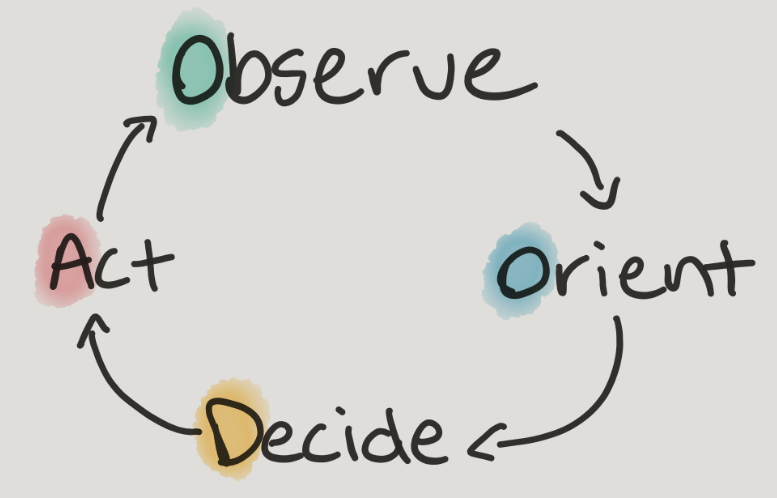
The OODA loop, created by military strategist John Boyd, is an acronym for “observe, orient, decide, act.” It is a cyclic process that emphasizes rapid decision-making and adaptability, enabling individuals or organizations to respond quickly to changing situations. The OODA loop consists of the following stages:
- Observe: Gather information about the environment and the problem at hand.
- Orient: Analyze the information, understand the context, and develop mental models to interpret the situation.
- Decide: Choose a course of action based on the analysis and mental models.
- Act: Execute the chosen course of action and observe the results.
Integrating Mental Models into the OODA Loop
In the “Orient” and “Decide” steps above, you see that the goal is to apply mental models to the OODA loop. Mental models are cognitive frameworks or concepts that help individuals interpret and process information. They are essential for effective decision-making and problem-solving, especially in complex or uncertain situations. Mental models can be integrated into the OODA loop to enhance its effectiveness. Examples of mental models include:
- Systems thinking: Understanding complex systems by breaking them down into components and examining their interrelationships.
- Occam’s Razor: Preferring the simplest explanation or solution when faced with multiple possibilities.
- First principles thinking: Deconstructing a problem into its fundamental principles and building solutions from there.
- Confirmation bias: Being aware of the tendency to seek out information that confirms existing beliefs and ignore information that contradicts them.
- Pareto principle: Recognizing that 80% of the effects often come from 20% of the causes.
By applying the OODA loop and mental models to problem-solving, you promote iterative thinking, adaptability, and creativity. For instance:
- In product or service development, use the OODA loop to gather feedback and make adjustments based on customer needs continually. Employ mental models like systems thinking and first principles thinking to break down complex problems and develop innovative solutions.
- In crisis or emergency situations, the OODA loop and mental models can enable rapid response to changing circumstances and decision-making under uncertainty. Utilize Occam’s Razor and the Pareto principle to simplify complex problems and focus on the most critical factors.
OODA: Real-World Examples
The OODA loop and mental models have been applied in various real-world situations to enhance problem-solving creativity and adaptability. The following examples demonstrate the practical application of these concepts in different contexts:
Toyota’s Production System and Continuous Improvement
Toyota, a leading automaker, has achieved remarkable efficiency in its production system by incorporating principles similar to the OODA loop. The company focuses on continuous improvement, known as “kaizen,” which entails observing manufacturing processes, orienting to issues, deciding on improvements, and acting upon those decisions (Liker, 2004). This iterative process has allowed Toyota to streamline its operations and maintain its position as one of the world’s most efficient automakers.
U.S. Military’s Use of the OODA Loop in Counterinsurgency Operations
The United States military has effectively applied the OODA loop in counterinsurgency operations in Iraq and Afghanistan. Military leaders consistently observe the environment, orient themselves to the situation, decide on a course of action, and act on that decision (Mattis & West, 2016). By doing so, they have been able to adapt to the ever-changing landscape of these conflicts and develop creative solutions to complex problems.
Agile Project Management and Software Development
The Agile methodology, widely used in project management and software development, follows a similar iterative process to the OODA loop. Agile teams consistently observe the progress of their projects, orient themselves to any changes in requirements or constraints, decide on appropriate adjustments, and act on those decisions (Rubin, 2012). This iterative approach allows for rapid response to feedback and fosters innovation.
Start Today
The power of cognitive frameworks, such as the OODA loop and mental models, cannot be overstated. By adopting such frameworks in your personal and professional life, you open the door to innovative thinking, improved decision-making, and the ability to stay ahead in an ever-changing world. In my personal life, I use the OODA method when it comes to fitness training and future investment planning. Professionally however, I use it for a myriad of things including future business strategy, relationship management, and product development. The use cases are endless and your goal is to make the application of OODA or whichever cognitive framework you choose to utilize an effortless endeavor. You need reps, so start today.
 lifeaccording2chr.is
Leave a comment